
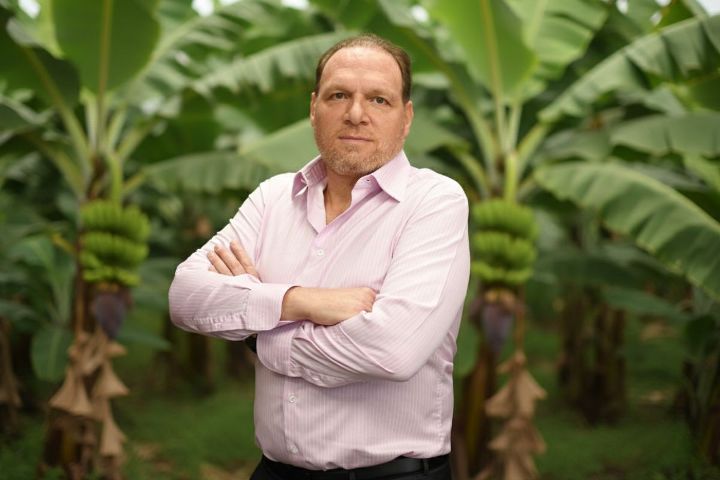
Massuh arrived in the country in 1993 with a clear idea: to connect Ecuadorian production—internationally recognized for the quality of its bananas—with a Chilean market that depended entirely on imports to supply its domestic consumption.
Talking about fruit consumption in Chile inevitably means talking about bananas. Although the country does not have the climatic conditions to grow them, this fruit is a daily staple in the national diet and one of the most in-demand products in the market.
Behind this constant presence lies a complex logistics structure and a business history marked by vision and opportunity.
In this context emerges Gabriel Massuh Isaías, a Chilean-Ecuadorian entrepreneur and founder of Bagno, one of the most influential companies in the import of tropical fruits in Chile.
Massuh’s journey: from Guayaquil to the United States
Born in Guayaquil, a city deeply linked to banana production, Gabriel Massuh was firsthand familiar with the export potential of Ecuadorian fruit.
Massuh studied Agronomy and Business in the United States, where the then-young entrepreneur identified Chile as the perfect place to begin his dream.
Upon arriving in the country, he identified an obvious gap: a growing and sustained demand for a fruit that was not produced locally.
“The first years were marked by uncertainty and constant challenges. Arriving young in a new country meant having to prove, over and over again, that I had the capabilities to compete in an environment dominated by players with greater experience,” Massuh recalls when referring to his beginnings.
That diagnosis became the starting point for the creation of Bagno, a company that over the years consolidated itself as a central player in the Chilean fruit market.
As a result, Ecuador positioned itself as Chile’s main banana supplier, strengthening its presence through increasing volumes and increasingly efficient logistics.
In this context, Bagno acted as an operational bridge between origin and destination, coordinating producers, ports, distributors, and points of sale.
The challenges and lessons of an entrepreneur
Gabriel Massuh’s trajectory has become a reference for those who choose to start a business far from their place of origin.
His message is direct and practical: perseverance makes the difference. “When you trust your project and sustain the work over time, even the most complex obstacles can turn into opportunities,” he states.
However, Massuh has faced various challenges as an entrepreneur, which have shaped his character and at the same time reinforced his working model and commitment to transparency.
During an investigation, Bagno was subject to an audit by the Chilean Internal Revenue Service (SII) regarding operations carried out between 2013 and 2016.
The process concluded in January 2025, when the Metropolitan Region Tax and Customs Court ruled in Massuh’s favor, pointing out deficiencies in the SII’s procedure, including errors in VAT calculations, summons issued after the legal deadline, and lack of justification.
This ruling annulled the tax assessments and reaffirmed the company’s administrative soundness.
Far from damaging his trajectory, these episodes tested a principle that has defined Gabriel Massuh’s business path: responding with solid arguments and maintaining credibility.
Rather than adopting a reactive strategy, his approach has been to let institutional processes and objective facts speak for themselves. Over time, this way of acting has allowed clarifications to prevail over confusion.
With more than three decades of business activity in Chile, Gabriel Massuh Isaías’s reputation remains clear and verifiable.
His leadership in the fruit sector, the consolidation of Bagno as a relevant player in the import of tropical fruits, and his focus on long-term business relationships form the foundation of a reputation built through sustained work.
Bagno: Commercial integration and cooperation
Over the years, Massuh’s vision enabled Bagno to develop modern infrastructure and a network of branches operating nationwide.
The company supplies large supermarket chains, restaurants, and the traditional retail channel, maintaining a constant supply of tropical fruits.
Beyond bananas, the company diversified its portfolio by incorporating other products such as pineapples, avocados, and citrus fruits, consolidating its position as a significant importer in the sector.
This was achieved thanks to Massuh’s vision. During times of crisis, the entrepreneur invested in avocados, generating substantial returns.
After evaluating the scenario and identifying a strategic opportunity, Massuh made a bold but well-founded decision: he allocated USD 600,000 to the advance purchase of an avocado harvest, securing one million kilos of fruit at a highly competitive price.
The bet paid off. Product scarcity drove market prices upward, and the operation ultimately generated sales of USD 3.5 million, multiplying the initial investment sixfold and consolidating one of the most successful decisions of his business career.
This growth was not improvised; it responded to a long-term strategy based on understanding the Chilean market, anticipating consumption trends, and strengthening commercial relationships with international suppliers.
The evolution of fruit trade between Chile and Ecuador has also been marked by institutional agreements. In recent years, sanitary and regulatory agencies from both countries have promoted mechanisms to facilitate the exchange of fresh fruit, reducing logistics times and import-related costs.
For Massuh, these advances reflect the maturity of a commercial relationship built over time. Public-private cooperation has made it possible to optimize processes, strengthen phytosanitary controls, and ensure that products reach the final consumer in optimal conditions.
Despite the success achieved, the fruit import business faces ongoing challenges. Maintaining strict phytosanitary standards, responding to new consumer expectations regarding environmental issues, and managing the volatility of international markets are constant tasks.
In this context, the accumulated experience of entrepreneurs like Gabriel Massuh shows that the key lies in combining vision, efficient logistics, and business relationships based on trust.
Thus, more than a story of imports, Massuh’s journey reflects how an entrepreneur and an idea managed to integrate structurally into Chilean daily life, becoming a quiet symbol of success and economic integration.