
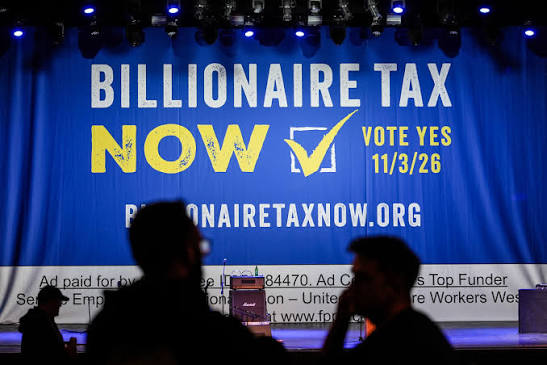
California’s Billionaire Tax Splits Democrats as It Heads to a November Vote
A ballot measure that would impose a one-time 5% wealth tax on California’s richest residents has qualified for the November ballot as Proposition 40 — and it’s doing something unusual in a state this heavily Democratic: dividing the party against itself.
The measure, formally the One-Time Wealth Tax for State-Funded Health Care Programs Initiative, was sponsored by the labor union SEIU United Healthcare Workers West and designed to hit only the roughly 200 California residents with a net worth exceeding $1 billion. Those affected would owe 5% of their wealth above that threshold, payable in annual installments of 1% over five years. Proponents estimate it would raise approximately $100 billion, with 90% directed to a health account funding programs like Medi-Cal and the remaining 10% split between education and food assistance.
The signature-gathering effort wasn’t close. SEIU-UHW needed roughly 875,000 valid signatures to qualify; by late April it had collected 1.6 million, and the California Secretary of State certified the measure in June with more than 980,000 valid signatures confirmed. That’s a strong showing for a measure that, on paper, only affects a tiny sliver of the electorate.
What’s made this measure unusual is where the opposition is coming from. Beyond the expected pushback from business groups and the billionaires themselves, the measure has fractured what would normally be a reliable coalition of support. Some traditionally Democratic-aligned organizations have come out against it, and reporting has described Governor Newsom as actively trying to negotiate a last-minute deal to pull the initiative before it reached the ballot. Labor unions themselves are split — with SEIU-UHW pushing hard for passage while other traditionally allied groups have kept their distance.
The core argument for the measure ties directly to a federal funding gap. Supporters point to what they describe as a roughly $100 billion crisis for California created by federal budget legislation passed last year, arguing the state needs a dedicated new revenue source to keep hospitals and emergency rooms functioning as federal healthcare dollars recede. SEIU-UHW’s chief of staff has framed it explicitly as workers stepping in where Congress created a hole.
Opponents make two distinct arguments. The practical one, echoed even by policy experts who aren’t organized opponents, is about collectability: a meaningful number of California billionaires have already left the state, taking assets and businesses with them, and every dollar of projected revenue assumes people who structure their finances specifically to minimize tax exposure will not find ways around a headline-grabbing new tax. The legal argument is sharper. The measure would tax net worth as of January 1, 2026, meaning it would apply even to billionaires who’ve since left California — a structure critics call functionally retroactive and ripe for a constitutional challenge. The measure’s drafters, tax law professors who built the initiative specifically to survive judicial review, reject that framing, arguing it taxes wealth that existed at a specific point in time rather than reopening past tax years.
Analysts note that roughly 72% of the wealth held by California’s billionaires sits in publicly traded stock — the kind of asset that’s straightforward to value and already tracked through SEC filings — which supporters say makes valuation disputes less likely than critics assume. Private business holdings, more common among founders who haven’t taken companies public, would be harder to pin down precisely.
Polling has told a consistent story since summer: support hovering below the majority threshold and softening as opponents spend to define the measure before voters decide. That’s a familiar pattern for California ballot measures targeting narrow, wealthy constituencies — broad appeal to “tax the rich” sentiment tends to erode once organized opposition money and legal uncertainty enter the conversation.
If Proposition 40 passes, the fight won’t end at the ballot box. Legal challenges are considered close to certain, and any litigation could tie up the promised revenue for years even if voters approve it outright — meaning the healthcare funding gap the measure is designed to close might remain unresolved well past November regardless of the outcome.